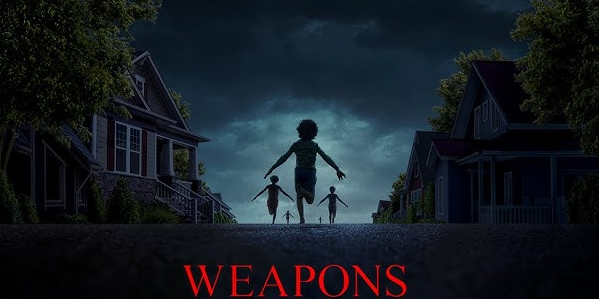
A missing person. A town with secrets. A cast that doesn’t blink. “Weapons” isn’t just a horror film—it’s a slow-burning descent into dread, built with surgical precision. Directed by Zach Cregger and featuring a powerhouse ensemble led by Josh Brolin and Julia Garner, the film has captivated audiences not with jump scares, but with its ability to make silence feel dangerous. This review explores the film’s creative process, visual language, and emotional architecture—without spoiling a single twist.
The Vision Behind the Film
Director Zach Cregger, known for his genre-defying approach, didn’t set out to make a conventional horror movie. Instead, “Weapons” was designed as a psychological labyrinth. The script reportedly went through multiple rewrites, each one stripping away exposition and adding ambiguity. The result is a film that trusts its audience to feel before they understand.
Cregger’s background in comedy may seem unexpected, but it’s precisely that tonal control that makes the film so unnerving. He knows how to build rhythm—and how to break it.
Location as Character
Filmed primarily in Pennsylvania and Georgia, the setting plays a crucial role. The town isn’t just a backdrop—it’s a living, breathing entity. The production team scouted locations that felt both familiar and off-kilter: diners with flickering neon, woods that seem too quiet, police stations that echo.
The cinematography leans into natural light and shadow. Scenes are often lit with a single source—a desk lamp, a streetlight, a candle—creating a sense of intimacy and isolation. Every frame feels like a photograph you weren’t supposed to see.
Casting That Cuts Deep
Josh Brolin’s portrayal of Archer Graff is restrained, deliberate, and quietly terrifying. Julia Garner brings a raw vulnerability to Justine, a character whose silence speaks louder than dialogue. Alden Ehrenreich, Benedict Wong, and Austin Abrams round out the ensemble with performances that feel lived-in, not performed.
Casting reportedly took months. Cregger wanted actors who could “hold tension in their eyes.” The chemistry between them isn’t loud—it’s loaded.
Sound Design as Storytelling
One of the film’s most praised elements is its sound design. There’s no overbearing score. Instead, ambient noise—creaking floors, distant sirens, wind through trees—takes center stage. When music does appear, it’s sparse and unsettling.
The sound team used analog techniques to create texture. Field recordings from abandoned buildings, distorted tape loops, and reversed audio snippets build a sonic landscape that feels haunted but never gimmicky.
Editing That Respects the Viewer
“Weapons” doesn’t spoon-feed its audience. The editing is patient, allowing scenes to breathe. Cuts are purposeful, often lingering just long enough to make you uncomfortable. Flashbacks are fragmented, memories are unreliable, and chronology bends without breaking.
This approach invites interpretation. Viewers become detectives—not just of the plot, but of the emotional truth behind each scene.
Costume and Production Design
The wardrobe is subtle but telling. Characters wear muted tones—grays, browns, faded blues—that reflect their emotional states. Nothing is flashy, but everything is intentional. A frayed jacket, a bloodstained cuff, a missing button—each detail adds to the narrative.
Set design follows suit. Spaces feel lived-in, slightly decayed, and emotionally charged. The police station isn’t pristine—it’s cluttered. Homes aren’t cozy—they’re claustrophobic. Every object feels like it has a story.
The Shoot: Controlled Chaos
Filming reportedly took place over 42 days, with a tight schedule and unpredictable weather. The crew embraced these challenges, using fog, rain, and natural decay to enhance the mood. Scenes were often shot in sequence to preserve emotional continuity.
Actors were encouraged to stay in character between takes. Improvisation was allowed—but only within the emotional framework of the scene. This created moments of raw authenticity that couldn’t be scripted.
Audience Reaction Without Spoilers
Viewers have described “Weapons” as “hypnotic,” “disturbing,” and “impossible to shake.” It’s not a film that ends—it lingers. The final scenes don’t offer closure, but confrontation. You’re left with questions, discomfort, and a strange sense of awe.
Critics have praised its refusal to conform. It’s horror without horror tropes. Drama without melodrama. Suspense without spectacle.
Why It Works
“Weapons” succeeds because it respects its audience. It doesn’t explain—it evokes. It doesn’t rush—it reveals. And it doesn’t rely on spectacle—it builds atmosphere from the ground up.
This is a film that understands fear isn’t loud—it’s quiet. It’s the pause before the scream. The glance that lasts too long. The door that’s slightly ajar.
Final Takeaway
“Weapons” is a masterclass in restraint. It proves that horror doesn’t need monsters—it needs mood. It doesn’t need gore—it needs gravity. And it doesn’t need answers—it needs honesty.
For filmmakers, it’s a lesson in control. For viewers, it’s a challenge to feel deeply. And for the genre, it’s a reminder that the most powerful stories are the ones that whisper.