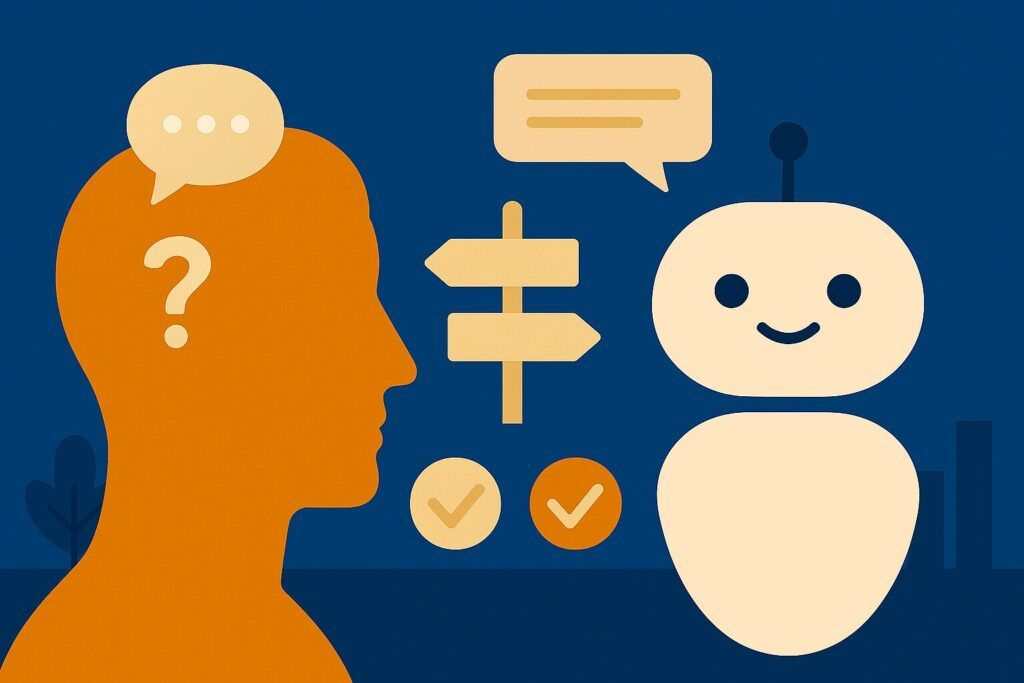
They’re not just answering questions—they’re shaping choices. From mental health support to shopping advice, chatbots have become silent partners in millions of daily decisions. Whether it’s Gen Z asking for emotional validation or professionals seeking quick summaries, AI conversations are changing how people think, feel, and act. This post explores the psychology behind chatbot reliance, the UX patterns that drive trust, and how creators can design AI experiences that empower rather than manipulate.
🧠 Chatbots Are No Longer Just Tools—They’re Interfaces for Thought
Chatbots used to be clunky FAQ bots. Now they’re fluent, adaptive, and emotionally responsive. People consult them for:
- Relationship advice
- Career dilemmas
- Mental health check-ins
- Shopping decisions
- Creative brainstorming
- Conflict resolution
- Even existential questions like “What should I do with my life?”
This shift marks a new phase in human-computer interaction: AI as a thinking partner.
📈 Search Behavior: What People Actually Type
Millions of users type queries like:
- “Best AI chatbot to talk to”
- “ChatGPT alternatives”
- “AI therapist app”
- “Should I trust chatbots?”
- “AI friend app”
- “Chatbot for decision-making”
- “Can AI help me make choices?”
These aren’t just tech questions—they’re emotional ones.
🧠 The Psychology Behind Chatbot Reliance
Why do people trust chatbots with personal decisions? Behavioral science offers clues:
| Psychological Driver | Chatbot Effect |
|---|---|
| Low judgment | Users feel safer sharing vulnerable thoughts |
| Instant feedback | No waiting, no scheduling—just answers |
| Cognitive offloading | Offloads mental effort, especially under stress |
| Emotional neutrality | No bias, no drama—just structured responses |
| Perceived intelligence | Fluency creates illusion of expertise |
People aren’t just using chatbots—they’re confiding in them.
🧩 Chatbots vs. Humans: What’s Changing?
| Interaction Type | Human Response | Chatbot Response |
|---|---|---|
| Emotional support | Empathy, but may be reactive | Calm, consistent, nonjudgmental |
| Decision guidance | Opinionated, context-bound | Structured, multi-perspective |
| Information retrieval | May lack precision | Fast, filtered, scalable |
| Availability | Limited by time and energy | 24/7, instant, scalable |
Chatbots don’t replace humans—but they fill gaps humans can’t.
🛠️ UX Patterns That Build Trust
Successful chatbot platforms use:
- Conversational pacing: Short, digestible replies
- Visual clarity: Clean UI, readable fonts, calming colors
- Memory cues: Referencing past messages builds continuity
- Tone modulation: Adjusting tone based on user emotion
- Transparency: Explaining limitations and boundaries
Trust isn’t just earned—it’s designed.
📊 Who’s Talking to Chatbots—and Why
| User Type | Chatbot Use Case |
|---|---|
| Gen Z | Emotional validation, identity questions |
| Millennials | Career advice, parenting support |
| Professionals | Brainstorming, writing, decision modeling |
| Creators | Idea generation, audience testing |
| Seniors | Companionship, reminders, health tracking |
Chatbots are not niche—they’re mainstream.
🧠 The Emotional Anatomy of AI Conversation
Chatbot interactions often follow this emotional arc:
- Curiosity: “Let’s see what it says…”
- Relief: “It understood me.”
- Validation: “That’s exactly what I needed to hear.”
- Reflection: “I hadn’t thought of it that way.”
- Attachment: “I prefer this to talking to people sometimes.”
This arc explains why users return—and why retention is high.
🔍 Chatbots in Decision-Making: A New Cognitive Layer
People now use chatbots to:
- Weigh pros and cons
- Simulate outcomes
- Reframe problems
- Explore emotional reactions
- Test hypothetical scenarios
It’s not just about answers—it’s about thinking through.
⚠️ Risks and Ethical Tensions
Chatbot reliance raises important questions:
- Overtrust: Users may treat AI as infallible
- Emotional dependency: Chatbots can become surrogate confidants
- Manipulation risk: Poorly designed bots may nudge behavior
- Privacy concerns: Sensitive data may be stored or misused
- Bias amplification: AI may reflect flawed training data
Creators must design with care, clarity, and ethical foresight.
🧠 How Creators Can Build Empowering Chatbot Experiences
To support healthy decision-making, creators should:
- Clarify boundaries: “I’m not a therapist, but I can help you think.”
- Offer frameworks: Decision trees, value mapping, scenario modeling
- Use affirming language: “It’s okay to feel uncertain.”
- Avoid overpromising: No “perfect answer” claims
- Design for reflection: Encourage journaling, pauses, and alternatives
Chatbots should guide—not dictate.
📈 Content Strategy: Building Around Chatbot Behavior
Creators can build content that complements chatbot use:
- Decision guides: “How to think through [X] with AI support”
- Emotional explainers: “Why talking to chatbots feels safe”
- Scenario templates: “Use this prompt to explore your options”
- Ethical breakdowns: “What chatbots can and can’t do”
- UX case studies: “Designing trust into AI conversations”
These formats attract high-intent users and build authority.
🧠 Final Thoughts
Chatbots aren’t just tools—they’re mirrors. Mirrors that reflect how people think, feel, and decide. As AI becomes more conversational, the line between interface and influence blurs. For creators, designers, and technologists, the challenge is clear: build systems that support human agency, not replace it.
Because when someone talks to a chatbot, they’re not just seeking answers. They’re seeking themselves.