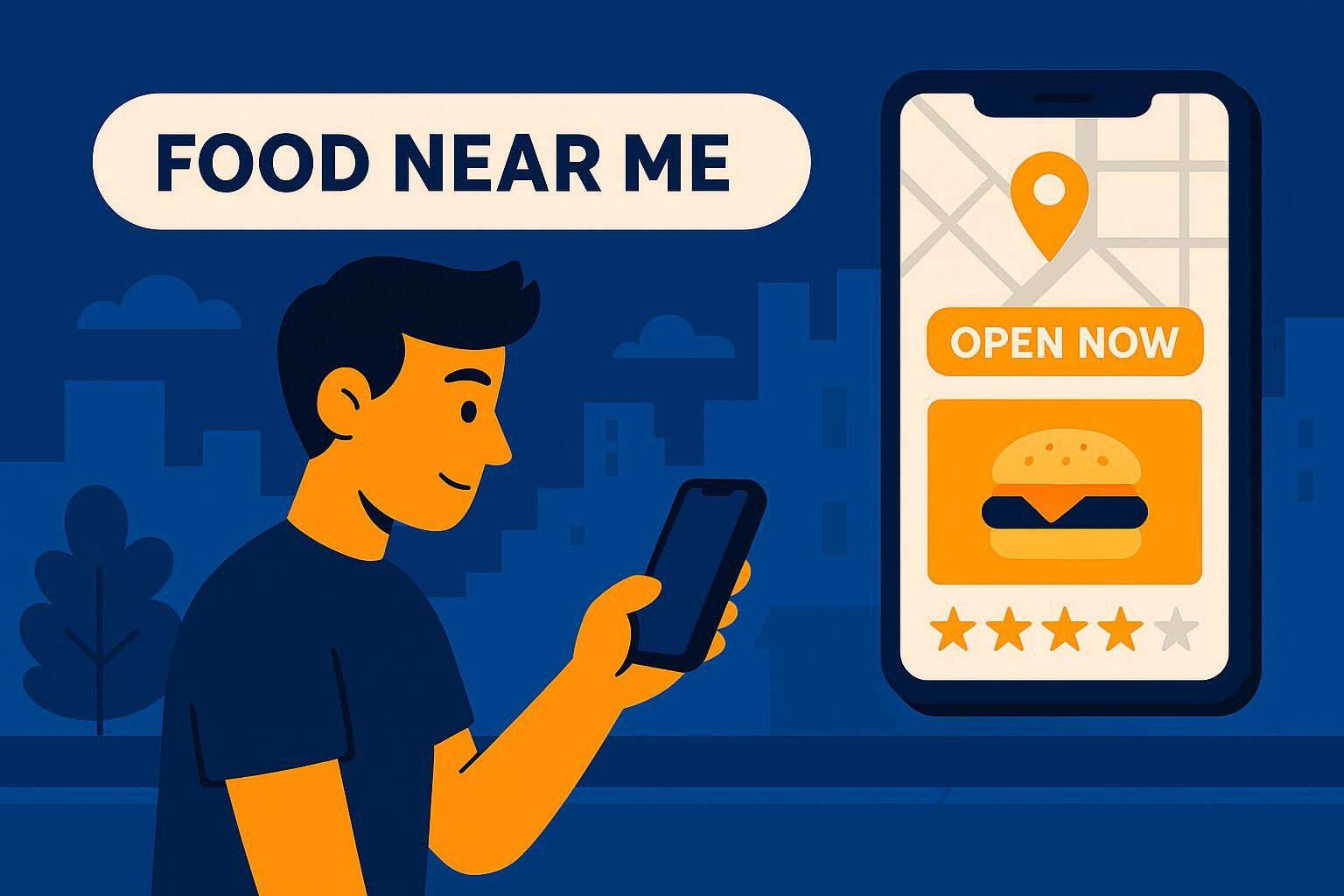
They aren’t gourmet queries. They’re human ones. “Food near me” distills hunger, time pressure, budget, mood, and convenience into three words—and mobile devices translate that urgency into action. The moment someone taps that phrase, they’re not browsing; they’re deciding. And the way platforms interpret this micro-intent is reshaping how restaurants are discovered, how diners evaluate choices, and how creators design content that shows up exactly when it matters.
The psychology of “near me”: hunger, habit, and the path of least resistance
“Near me” queries are born from immediacy. A diner is not planning a dream trip or researching a major purchase; they’re solving for now. That creates a distinct psychological profile:
- Need-state urgency: The diner wants an option within minutes, not hours.
- Cognitive offloading: Instead of recalling options, they delegate discovery to their phone.
- Satisficing vs. maximizing: They seek “good enough” that fits preferences (open, close, trusted, affordable) rather than the absolute best.
- Micro-identity signaling: Dietary needs, social context, and mood shape the choice (vegan, date night, kid-friendly, late-night).
This is why small friction—missing hours, outdated menus, weak photos—kills intent. In near-me moments, clarity beats cleverness.
From generic to hyper-specific: how queries encode intent
“Food near me” is only the opening move. Real-world behavior branches quickly into modifiers that encode richer intent:
- Food type: “Thai near me,” “sushi near me,” “vegan lunch near me.”
- Occasion: “Birthday dinner near me,” “romantic restaurants near me.”
- Constraints: “Open now,” “open late,” “open on Sunday,” “kid-friendly.”
- Dietary rules: “Gluten-free,” “halal,” “keto,” “dairy-free.”
- Price and speed: “Cheap eats,” “fast,” “takeout,” “delivery.”
Recent industry reporting shows that users have shifted away from broad “restaurants” searches toward highly specific, hyperlocal patterns, with AI-driven interfaces personalizing results by history, time, and even weather. Separately, aggregated behavior analyses highlight that consumers demand rapid outcomes and disproportionally click the top results, with the first organic listing capturing around a quarter to a third of clicks while almost no one visits page two. Together, these forces explain why the right detail in the right place at the right moment wins.
Mobile-first discovery: what the data says about diner behavior
Three signals consistently emerge in recent analyses of restaurant search behavior:
- Dominant discovery channel: A majority of consumers now find restaurants through general web search, not legacy directories. Within that journey, “near me” queries have surged, and sub-intents like “food near me open now” have grown at a blistering pace.
- Review reliance: The overwhelming majority read reviews before deciding, and mid-to-high star ranges drive the most engagement, with image-rich profiles outperforming sparse ones.
- Visual validation: A large share of diners report visiting a venue after viewing compelling food photos; image quality meaningfully shifts footfall in the last mile.
These patterns align with the impatience and outcome-seeking mindset documented in broader consumer behavior: quick decisions, minimal scrolling, and trusted visual signals.
How platforms decide: the invisible ingredients behind local results
When someone types “food near me,” multiple signals blend to produce results:
- Proximity and real-time context: Distance, current time, and day-of-week availability.
- Entity completeness: Name, address, phone, hours, category, attributes (dine-in, takeout, delivery, outdoor seating).
- Freshness and consistency: Recently updated menus, posts, photos, and specials; consistent details across web mentions.
- Relevance cues: Matching query modifiers to attributes (“gluten-free,” “kid-friendly”).
- Reputation graph: Volume, velocity, and valence of reviews; photo recency; response behavior.
- Behavioral feedback: Click-throughs, call taps, directions requests, and the “stickiness” of profile interactions.
Industry coverage indicates personalization has intensified, including AI-powered suggestions tuned to user history and conditions like time of day or weather, pushing the system toward contextual relevance over static ranking. That shift rewards creators who keep profiles accurate, photo-forward, and attribute-rich—because the algorithm needs structured signals to serve the human moment.
The mobile decision loop: four steps that repeat all day
- Spark: Hunger, a social plan, or a schedule gap.
- Micro-question: “What’s good and close right now?”
- Scan: Top results, map pins, star ratings, open/close labels.
- Micro-filter: “Open now, not too expensive, looks clean.”
- Validate: Photos, reviews, menu availability, recent posts.
- Micro-proof: “Pictures look legit, reviews mention crispy fries, they do gluten-free buns.”
- Act: Tap to call, directions, or order online.
- Micro-commitment: “We’re going.”
Data points show that most diners never go past the first screen; the top few results absorb the clickshare, and visuals tip the decision at the edge.
Why photos, menus, and hours carry outsized weight
In near-me contexts, diners slice time into minutes. They scan for:
- “Open now” certainty: No one wants to arrive to locked doors; accurate hours curb abandonment.
- Menu fit: Dietary tags and prices reduce friction—hidden or out-of-date menus push users elsewhere
- Authentic visuals: Real dishes, ambient shots, and up-to-date storefront images convert curiosity into visits.
Restaurants that maintain high-quality photos and live-accurate details capture intent in the last 60 seconds of decision-making.
Voice, glance, and zero-typing behaviors
Near-me isn’t always typed. It’s often spoken or tapped:
- Voice: “Hey, find tacos near me open now.” Systems map speech to structured constraints (cuisine, time, proximity).
- Glanceable surfaces: Home screen widgets and map previews compress decisions into one or two taps.
- One-tap actions: Call buttons, “order online,” and quick directions reduce falloff.
The platforms increasingly deliver suggestions without full queries, leaning on AI to pre-rank likely fits—another reason completeness and freshness of business data matter.
Social proof anatomy: what reviews actually communicate
People don’t read every review; they pattern-match:
- Recency bias: Reviews from the last few weeks carry more weight than older praise.
- Photo-backed claims: Statements paired with images amplify trust.
- Specificity: Mentions like “crispy wings,” “spacious patio,” “quiet on weekdays,” or “great for toddlers” map directly to use-cases.
Because most diners consult reviews before deciding—and trust them at levels comparable to personal recommendations—thoughtful owner responses and steady photo flow quietly expand the reputation edge.
The hidden win: attributes and micro-moments
Attributes are the unsung heroes of “near me”:
- Experience tags: “Outdoor seating,” “live music,” “good for groups,” “romantic.”
- Access tags: “Wheelchair accessible,” “restroom,” “parking.”
- Diet tags: “Gluten-free,” “vegan options,” “halal.”
When query language, platform attributes, and profile content harmonize, the diner feels seen. Industry guidance emphasizes the advantage of structured data and profile upkeep in aligning with AI-driven suggestions.
How “food near me” shapes content strategy for creators
For publishers, brands, and local businesses, this behavior suggests a creative and technical playbook:
- Design for the five-second scan: Lead with a single decisive image and a one-sentence promise (what you’re known for).
- Narrate use-cases, not adjectives: “Late-night ramen after concerts,” “Kid-friendly brunch with lawn games,” “Quick vegan lunch by the park.”
- Structure over poetry: Clear headings, consistent data blocks (hours, address, ordering), and attribute tags beat flowery prose in near-me moments.
- Build for glanceable surfaces: Cards, lists, and map embeds outperform long paragraphs on mobile.
- Surface constraints: Price range, wait times, parking, and dietary accommodations reduce second-guessing.
- Refresh cadence: New photos weekly, seasonal menus, and timely posts keep profiles “alive” to both people and algorithms.
These moves are not about gaming a system; they’re about translating human need into machine-readable clarity.
A practical content framework for “near me” pages
Use this structure for any venue, city guide, or “best of” roundup that aims to capture near-me demand:
- Headline promise: “Fast, fresh tacos a block from the river.”
- Micro-summary: 15–25 words that state cuisine, vibe, timeframe, and signature.
- Decision bar: Hours today, price icons, dietary badges, quick actions (call, directions, order).
- Top three photos: One hero dish, one people-in-space shot, one exterior/entrance.
- Use-case bullets: “Late-night takeout,” “Kid-friendly patio,” “Gluten-free buns available.”
- Live menu link + highlights: 3–5 items with short descriptors and price anchors.
- Social proof capsule: 2–3 quoted snippets paired with user photos.
- Neighborhood context: Transit, parking, nearby landmarks.
- Owner note (optional): 50–80 words about sourcing, story, or seasonal specials.
- Accessibility note: Clear, respectful, specific.
This format aligns with how diners scan on phones while supporting algorithmic understanding of what your content solves.
Measurement without vanity metrics
Track what aligns with human intent:
- Tap-throughs to actions: Calls, directions, order taps—more meaningful than raw pageviews.
- First-screen engagement: Time to first interaction within three seconds.
- Photo conversion: Views on top photos vs. profile visits; measure after new uploads.
- Query-to-page fit: Entry queries that start with “near me,” “open now,” cuisine + neighborhood.
The broader analytics story is clear: users reward immediacy and clarity, and the biggest slice of clicks concentrates at the top of visible results.
Advanced tactics for local visibility without overcomplication
- Consistency graph: Keep name, address, and phone uniform across your site, profiles, and listings.
- Structured signals: Use menus and attributes that mirror real offerings; keep hours accurate across holidays.
- Real-time cues: Post daily specials, sold-out notices, and live wait times to reduce uncertainty.
- Context posts: Tie offerings to weather or events (“Cold day? Hot pho bowl.”); AI systems increasingly weigh context.
- Image discipline: Favor real, well-lit photos over overproduced stock; diners follow authenticity.
Every tactic exists to serve a person who is deciding fast.
“Open now” and “open late”: the most decisive modifiers
Why these modifiers matter:
- They compress choice: Any result not open is immediately disqualified.
- They shift maps: Pins and lists reorder based on current availability.
- They anchor expectation: Accuracy builds trust; errors erase it.
Analyses of restaurant discovery show dramatic growth in “open now” style searches and heavy mobile origin for these queries, underlining the importance of accurate hours and live status. Platforms also emphasize keeping profiles current because personalization leverages these facts automatically.
The role of delivery and takeout in near-me intent
“Near me” often ends at a delivery button. Design content for both paths:
- On-premise: Photos that show seating, atmosphere, and entrance.
- Off-premise: Containers, portion clarity, delivery-friendly dishes, and fees.
- Order clarity: Direct links, estimated prep times, and reheat tips.
Remember that mobile users compare the “tap journey” as much as the food: fewer screens and fewer doubts win.
Accessibility and inclusivity are discoverability
Accessibility signals are not just ethical; they’re pragmatic:
- Entrances and restrooms: Clear, specific statements help those who need certainty.
- Menus for all: Alt text for images, readable contrast, dietary filters.
- Pricing transparency: No surprises on fees or minimums.
Attributes that confirm inclusivity map directly to user modifiers in “near me” searches and can shape results for people whose constraints are non-negotiable.
For creators and publishers: turning behavior into editorial formats
Build franchises around the ways people actually choose:
- “Open now near [landmark]” snapshots: Rotating, time-sensitive lists that refresh automatically.
- Micro-itineraries: “One hour, three bites” routes for lunches and layovers.
- Diet-first guides: “Gluten-free comfort food within 10 minutes of downtown.”
- Mood maps: “Quiet cafés for deep work,” “Loud and lively for celebrations.”
- Price-path posts: “$10 lunches within walking distance of campus.”
Each format encodes constraints that diners care about and platforms can parse.
What not to do: the four fastest ways to lose a near-me click
- Stale hours: Few things frustrate more than arriving to a closed door.
- Hidden menu info: Forcing PDF downloads or burying prices drives bounces.
- Low-res or misleading photos: Overpromising images backfire when reality disagrees.
- Inconsistent details: Conflicting addresses, phone numbers, or names erode confidence.
These are fixable. And they’re disproportionately costly in near-me contexts.
The creator’s compass: human first, machine legible, mobile native
A simple mantra guides winning “near me” content:
- Human first: Solve a person’s minute-by-minute needs.
- Machine legible: Give platforms the structured hints they require.
- Mobile native: Design for one-handed, 5-second decisions.
The result isn’t just visibility; it’s usefulness at the moment it matters most.
Closing reflections: the most human query in a machine-mediated world
“Food near me” looks simple. It is anything but. Those three words compress appetite, schedule, budget, mood, and social context—and ask a device to translate them into dinner. Platforms increasingly honor that human complexity through real-time context and personalization. Behavior signals show that people respond to clarity and immediacy, flocking to the top options and rarely scrolling further. And across the last mile of decision-making, reviews and photos act as the language of trust, nudging a tap into a meal.
For creators, brands, and restaurants, the opportunity is generous and exacting: show the right promise, prove it fast, and keep your signals alive. Win the minute, and you win the meal.