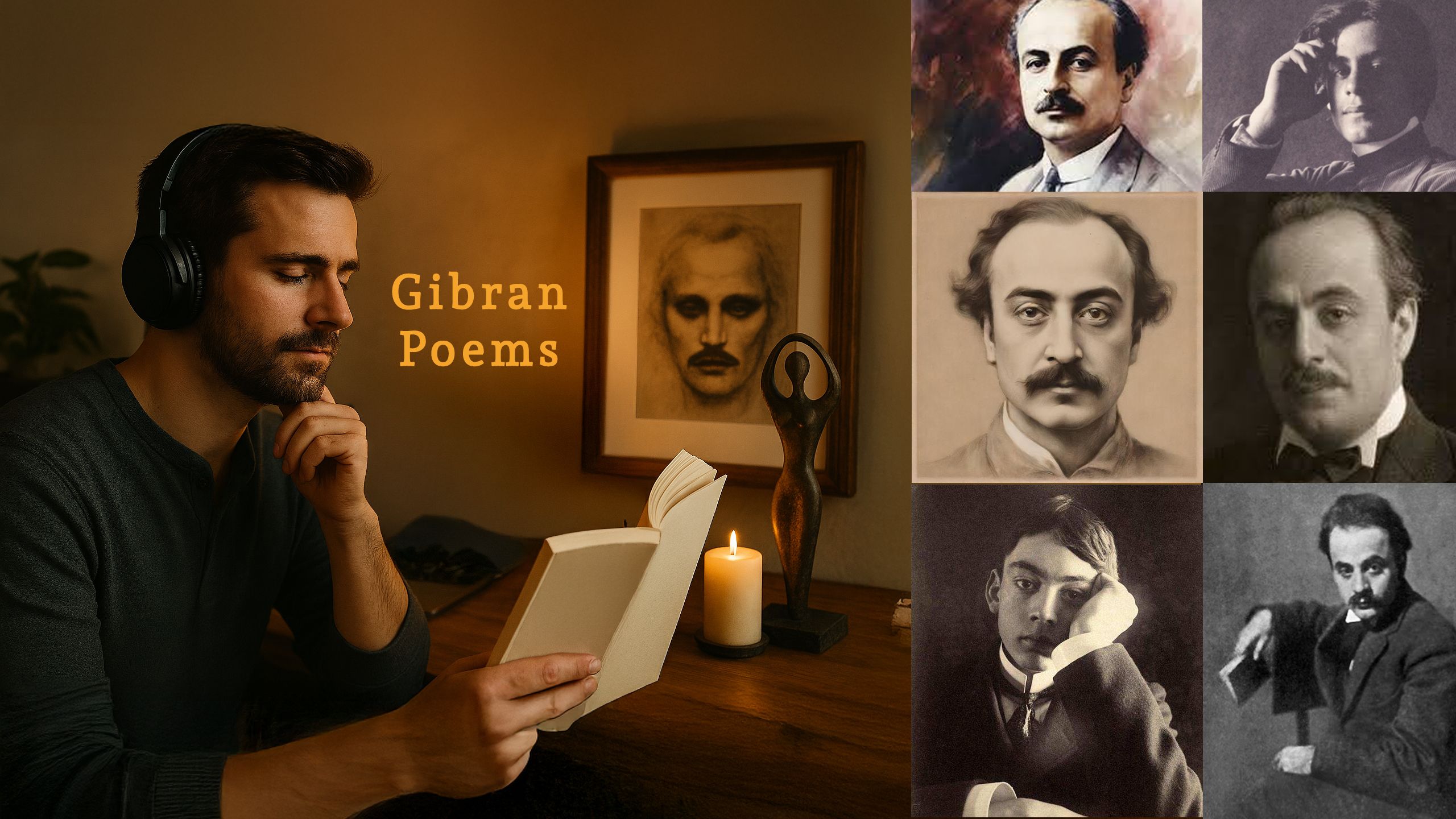
In a quiet corner of YouTube, a voice rises—not loud, but luminous. GibranPoems is a Youtube channel dedicated to the timeless words of Kahlil Gibran, the Lebanese-American poet whose prose dances between mysticism and clarity. Here, his stories are not just read—they’re felt. Each video offers a moment of stillness, a breath of meaning, and a bridge between generations. Before we explore the life behind these words, we begin with the voice that carries them forward.
🎙️ GibranPoems: Breathing Life Into Timeless Texts
The GibranPoems channel is more than a reading archive—it’s a revival. With carefully selected excerpts from Gibran’s most resonant works, each video invites listeners into a meditative space. Whether it’s “On Children,” “On Love,” or reflections from The Madman, the channel curates not just content, but emotional experience.
- Tone: Calm, reverent, emotionally grounded
- Format: Short readings, ideal for reflection or daily inspiration
- Audience: Lovers of poetry, seekers of meaning, students of philosophy
- Impact: Reintroduces Gibran’s voice to a digital generation
This channel is a living tribute—one that honors not just the words, but the silence between them.
https://www.youtube.com/@GibranPoems
🧠 Who Was Kahlil Gibran / Khalil Gibran ?
Born in 1883 in the village of Bsharri, nestled in the mountains of what is now Lebanon, Gibran Khalil Gibran emigrated to the United States with his mother and siblings at the age of 12. They settled in Boston’s South End, a melting pot of immigrant life and hardship. It was there that Gibran’s artistic talents first caught the eye of a local publisher, setting him on a path that would span continents and disciplines.
✍️ The Writer and Philosopher
Though Gibran rejected the label “philosopher,” his writing often carried philosophical weight. His most famous work, The Prophet (1923), is a collection of poetic essays delivered by a fictional sage named Almustafa. Topics range from love and marriage to freedom and death—all rendered in lyrical, non-sectarian prose.
- Style: Symbolic, spiritual, accessible
- Language: Wrote in both Arabic and English
- Themes: Unity, love, sorrow, joy, freedom, the divine
- Legacy: The Prophet has been translated into over 100 languages and sold tens of millions of copies
Gibran’s writing blends Eastern mysticism with Western romanticism, creating a universal language of the soul.
🎨 The Visual Artist
Gibran was also a painter and illustrator. He studied art in Paris at the Académie Julian, producing hundreds of works that often mirrored the symbolism in his writing. His illustrations for The Prophet are ethereal and haunting, reinforcing the spiritual tone of the text.
- Mediums: Pencil, watercolor, oil
- Subjects: Human figures, symbolic forms, nature
- Exhibitions: Montross Gallery (1914), Knoedler & Co. (1917)
His art, like his prose, invites contemplation rather than interpretation.
📚 Other Notable Works
Beyond The Prophet, Gibran authored several other influential texts:
- The Madman (1918): A collection of parables and aphorisms
- Broken Wings (1912): A tragic love story set in Beirut
- Jesus, The Son of Man (1928): A poetic retelling of Christ’s life through imagined witnesses
- Sand and Foam (1926): Aphorisms and poetic fragments
Each work reflects a different facet of Gibran’s inner world—sometimes mystical, sometimes melancholic, always sincere.
🌍 Cultural Impact
Gibran’s influence extends far beyond literature:
- 1960s Counterculture: His spiritual humanism resonated with movements seeking meaning beyond materialism
- Modern Psychology: His reflections on sorrow, identity, and love are often quoted in therapeutic contexts
- Global Reach: Revered in both East and West, Gibran is one of the most widely read poets of all time
His words continue to appear in weddings, funerals, classrooms, and quiet moments of reflection.
🧩 What Makes Gibran Timeless?
| Element | Why It Resonates |
|---|---|
| Universal themes | Love, loss, freedom, identity—always relevant |
| Poetic clarity | Deep ideas in simple language |
| Spiritual openness | Non-dogmatic, inclusive, emotionally rich |
| Emotional cadence | Rhythm that mirrors inner thought |
| Visual imagination | Words that paint, images that speak |
Gibran doesn’t just write—he listens. And in his listening, readers hear themselves.
🧠 Final Reflections
Kahlil Gibran’s legacy is not just in the books he wrote or the paintings he made—it’s in the questions he asked. Questions about love, about pain, about the soul’s journey. Through your YouTube channel, GibranPoems these questions find new breath. They echo not in lecture halls, but in headphones, living rooms, and quiet walks.
Because Gibran’s gift was never just language—it was presence. And in every reading, that presence returns.